Tuesday, 11 June 2013

AZOTEMIA

Azotemia refers to an elevation of blood urea, nitrogen and creatinine levels and is largely related to reduced GFR. It is without clinical manifestations but can be seen in biochemical index.

Its progression to clinical manifestations and systemic biochemical abnormalities is termed UREMIA.  Uremia is not characterized by failure of renal excretory functions only but also by a host of metabolic and endocrine alterations incident to renal failure. There are also secondary manifestations like uremic gastroenteritis, pheripheral neuropathy and cardiovascular involvements ( uremic pericarditis).

Azotemia can be classified by its pathological relation to the kidney as
1. Pre-renal: it include any extra renal disease that reduces perfussion of the kidneys and reduce GFR.
2. Renal: includes diseases of the kidney and occurs in Nephritic syndrome, renal failure
3.Post-renal: occurs as a result of obstruction to urine flow.

                                                                                                                        PEACE

Monday, 10 June 2013

FATIGUED at end of school year?

Its a privilege  to make out time to write again. I am so sorry i have been missing in action for a while.
Well today, i will be expressing my view on fatigue.

Its ending of school session around the world and we as students are all eager to finish school year and start our vacation. As it seems, due to this reason, quite a couple of us are just in school in body but our mind is off school. I wonder if its nostalgic feelings about having 2 months of our own timetable or .......
Well i really can't say what the reason for this is as we struggle to read and pass our exams in time.
On my end, i have discovered many are in a state of  FATIGUE. 
Fatigue could be physical or mental.

Tiredness is a psychological state of being. It is a transient decrease in maximal cognitive performance resulting from prolonged periods of cognitive activity. It can manifest as somnolence or lethargy. It is also being regarded as mental fatigue and can't be clinically measured.

Whereas, physically fatigue people can be clinically observed and treated with rest and other beneficial therapies. This form of fatigue can be measured as body fluid indexes could show changes. sleep deprivation in these end period alongside with continuous studying and reduced eating could cause this and note its just for a while because its reversible.

So friends, i indulge you all to finish the race in time. Put in more efforts, don't relent, keep pushing and remember the G- factor for with God alone is success possible.

                                                                                                                                            PEACE
                                                                                                                                               

Monday, 27 May 2013

Post 101


Non-medic friend: “Hey, how was your day?”
CMM: “Oh, yeah it was pretty good…had class all day though.”
Non-medic: “I heard that medical students dissect rats…isn’t that really gross??”
CMM: “Well…erm….we don’t dissect rats actually….we dissect other stuff.”
Non-medic: “What do you dissect then?”
CMM: “Uhhh..people.”
*cue freak out from non-medic, with much proclaiming of “urghghghgh how could you do that?”, “omggggggg I’m gonna be sick?!” etc.*
The medical school that I attend (which shall remain anonymous in case the GMC decide to slay me for anything I may say in the future) uses cadaveric dissection as a way to teach anatomy, alongside lectures obviously.  We dissect from for a considerable amount of time each week, starting in the very first week of first year.
And yes, it was and is really pretty gross.  The first time we dissected, the entire class was silently freaking out, worrying who was going to be the one to faint or vomit or burst into tears.  Interestingly, as far as I am aware, that didn’t happen to anyone, and I have only ever seen one person faint in the dissecting room and I think that was just from standing up for too long rather than from touching a dead body.
Whilst dissecting, most of the time my thoughts are along the lines of “Where the fuck is the bloody nerve…oh there is it…oh wait no.  Aaah don’t cut my fingers off. Oh there it is…is it??  Nah….  I’m hungry, yay only 10 minutes till home time!” but every now and again it’s more like “Muscles muscles muscles omg this person was actually a person with thoughts and feelings and a family.  This person got up every morning and put socks on the feet which I am ripping apart with my scalpel.  They probably ate pizza and sandwiches and knew how to swim.  This was someone’s best friend.  They would’ve started school and been terrified.  They had a job, they had a car, then had a house.  They watched TV and read books.  In short, they are just like me.”.
And I’m relieved I have those thoughts.  Intrusive and distracting as they are, I hope I never forget that these people are not just corpses filled with formaldehyde.  They had stories and lives and dreams.  And they were wondering, generous, thoughtful people who had the courage and selflessness to decide to donate their bodies to my medical school for teaching purposes.
Every time we go into the dissecting room, we come scarily close to death.  With the exception of seeing some horrendous car crash, or having a relative pass away or attending a funeral, most people live their lives avoiding death.  This is not the same for medical students or doctors.  Every day we come are faced with our own mortality, we see the fact that life is so precarious and so finite that when we are gone, we are gone.  I’m going to assume that as I get older, I will become less emotionally involved with these things – people have told me that you never forget your first patient, but after that, it’s only the odd few who really make an impact on you.  Deep down, I hope I never lose the shocking innocence I have.  The fact that every time I interview a patient, I feel sad for them and don’t stop thinking about them for days.  The fact that I will never, ever forget the face of the cadaver I spent the year dissecting.  But then, I suppose it would be hard to practice Medicine like this without ending up in a Psychiatric ward something, and I really hope that doesn’t happen to me!

Monday, 20 May 2013

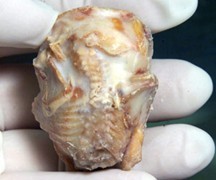
lithopedion or stone baby


In an ectopic pregnancy, if the dead foetus is too large to be re-absorbed by the mother's body it becomes a foreign body to the mother's immune system. To protect itself from possible infection the mother's body will encase the foetus in a calciferous substance as the tissues die and dehydrate.
As the calciferous wall builds up, the foetus is gradually mummified becoming a lithopedion or stone baby.
Probably you have never heard of it, it does exist.
Dissected Foetus
Dissected stone baby
Lithopedion Baby
A stone baby

KOBOKO VS MEDICINAL DRUGS IN ATTENTION DEFICIT HYPERACTIVITY DISORDER.


ADHD today is the most commonly studied child psychiatric disorder
and well there there had been a say from the beginning of time for its cure.
Foolishness is bound in the heart of a child; but the rod of correction shall drive it far from him. (Holy Bible prov22vs15).
Recently, i came by a comic picture of the typical Nigerian cane (koboko) with a tag that its been saving life since...........it was discovered it could bring pain that will make a child sober and think. However this brings us to the daily increase in number of children being diagnosed of this illness and it brings this question to mind, Do we have it in Africa?
"ADHD is found to be as prevalent on the African continent as in
Western countries (Meyer, 1998; Meyer, Eilertsen, Sundet, Tshifularo,
& Sagvolden, 2004). The predominant Western approach to
understanding mental disorders is based on a biomedical perspective that
regards primary syndromes as universal and similar across diverse human
cultures. A basic question is to what degree behaviour and its disturbances
are affected by culture".
The inability to inhibit behavioral responses leads to risk taking
behaviour like drug and alcohol abuse, tobacco smoking, premarital and
promiscuous sex, driving anger and traffic offences, accident proneness,
compulsive buying and tattooing and body piercing (Barkley, 2004;
Barkley, Fischer, Smallish, & Fletcher, 2004; Carroll, Riffenburgh,
Roberts, & Myhre, 2002; Fillmore & Rush, 2002; Kahn, Kaplowitz,
Goodman, & Emans, 2002; Lam, 2002; Molina, Bukstein, & Lynch, 2002;
Roberts & Tanner, Jr., 2000; Tercyak, Lerman, & Audrain, 2002).
A high incidence of crime, substance abuse, and especially the very
high rate of HIV infection in South Africa, and its possible relationship to
ADHD, necessitated an investigation into the prevalence and neuropsychological manifestations of the disorder.
So how true is this, will the African child have to be subjected to those drugs Americans think has its management abilities or do we go back to our use of native admonishments like local koboko, pankere and its like?
Pls do comment as ur feedbacks are of utmost importance.

Wednesday, 8 May 2013

Mitosis


It consists of two main stages.
Karyokinesis : This is the main part of cell division, which is the division of the nucleus. It is further divided into four stages.
  • Prophase : The nucleus of the cell breaks apart. The individual chromsomes are visible as the chromatids condense.
  • Metaphase : The centromeres of the chromosomes align along what is called as the metaphase plate.
  • Anaphase : The chromatids separate and get pulled apart by the mitotic spindles forming two arrangements.
  • Telophase : The chromatids condense and form the two daughter nuclei of the cell.
Cytokinesis : This stage happens simultaneously with Telophase. It is the final stage where a cleavage is created in the cytoplasm and the cell separates into two daughter cells. The two daughter nuclei pass into the daughter cells.

Individual Brain cells....


UCLA study shows that individual brain cells track where we are and how we move

Using virtual reality, neurophysicists determine how environmental stimuli and brain rhythms generate our neuronal maps of the world

Place cells
Place cells in the real world (l) and in virtual reality. (Click for details.)
Leaving the house in the morning may seem simple, but with every move we make, our brains are working feverishly to create maps of the outside world that allow us to navigate and to remember where we are.
 
Take one step out the front door, and an individual brain cell fires. Pass by your rose bush on the way to the car, another specific neuron fires. And so it goes. Ultimately, the brain constructs its own pinpoint geographical chart that is far more precise than anything you'd find on Google Maps.
 
But just how neurons make these maps of space has fascinated scientists for decades. It is known that several types of stimuli influence the creation of neuronal maps, including visual cues in the physical environment — that rose bush, for instance — the body's innate knowledge of how fast it is moving, and other inputs, like smell. Yet the mechanisms by which groups of neurons combine these various stimuli to make precise maps are unknown.
 
To solve this puzzle, UCLA neurophysicists built a virtual-reality environment that allowed them to manipulate these cues while measuring the activity of map-making neurons in rats. Surprisingly, they found that when certain cues were removed, the neurons that typically fire each time a rat passes a fixed point or landmark in the real world instead began to compute the rat's relative position, firing, for example, each time the rodent walked five paces forward, then five paces back, regardless of landmarks. And many other mapping cells shut down altogether, suggesting that different sensory cues strongly influence these neurons.
 
Finally, the researchers found that in this virtual world, the rhythmic firing of neurons that normally speeds up or slows down depending on the rate at which an animal moves, was profoundly altered. The rats' brains maintained a single, steady rhythmic pattern.
 
The findings, reported in the May 2 online edition of the journal Science, provide further clues to how the brain learns and makes memories.
 
The mystery of how cells determine place
 
"Place cells" are individual neurons located in the brain's hippocampus that create maps by registering specific places in the outside environment. These cells are crucial for learning and memory. They are also known to play a role in such conditions as post-traumatic stress disorder and Alzheimer's disease when damaged.
 
For some 40 years, the thinking had been that the maps made by place cells were based primarily on visual landmarks in the environment, known as distal cues — a tall tree, a building — as well on motion, or gait, cues. But, as UCLA neurophysicist and senior study author Mayank Mehta points out, other cues are present in the real world: the smell of the local pizzeria, the sound of a nearby subway tunnel, the tactile feel of one's feet on a surface. These other cues, which Mehta likes to refer to as "stuff," were believed to have only a small influence on place cells.
 
Could it be that these different sensory modalities led place cells to create individual maps, wondered Mehta, a professor with joint appointments in the departments of neurology, physics and astronomy. And if so, do these individual maps cooperate with each other, or do they compete? No one really knew for sure.
 
Virtual reality reveals new clues
 
To investigate, Mehta and his colleagues needed to separate the distal and gait cues from all the other "stuff." They did this by crafting a virtual-reality maze for rats in which odors, sounds and all stimuli, except distal and gait cues, were removed. As video of a physical environment was projected around them, the rats, held by a harness, were placed on a ball that rotated as they moved. When they ran, the video would move along with them, giving the animals the illusion that they were navigating their way through an actual physical environment.
 
As a comparison, the researchers had the rats — six altogether — run a real-world maze that was visually identical to the virtual-reality version but that included the additional "stuff" cues. Using micro-electrodes 10 times thinner than a human hair, the team measured the activity of some 3,000 space-mapping neurons in the rats' brains as they completed both mazes.
 
What they found intrigued them. The elimination of the "stuff" cues in the virtual-reality maze had a huge effect: Fully half of the neurons being recorded became inactive, despite the fact that the distal and gate cues were similar in the virtual and real worlds. The results, Mehta said, show that these other sensory cues, once thought to play only a minor role in activating the brain, actually have a major influence on place cells.
 
And while in the real world, place cells responded to fixed, absolute positions, spiking at those same positions each time rats passed them, regardless of the direction they were moving — a finding consistent with previous experiments — this was not the case in the virtual-reality maze.
 
"In the virtual world," Mehta said, "we found that the neurons almost never did that. Instead, the neurons spiked at the same relative distance in the two directions as the rat moved back and forth. In other words, going back to the front door-to-car analogy, in a virtual world, the cell that fires five steps away from the door when leaving your home would not fire five steps away from the door upon your return. Instead, it would fire five steps away from the car when leaving the car. Thus, these cells are keeping track of the relative distance traveled rather than absolute position. This gives us evidence for the individual place cell's ability to represent relative distances."
 
Mehta thinks this is because neuronal maps are generated by three different categories of stimuli — distal cues, gait and "stuff" — and that all are competing for control of neural activity. This competition is what ultimately generates the "full" map of space.
 
"All the external stuff is fixed at the same absolute position and hence generates a representation of absolute space," he said. "But when all the stuff is removed, the profound contribution of gait is revealed, which enables neurons to compute relative distances traveled."
 
The researchers also made a new discovery about the brain's theta rhythm. It is known that place cells use the rhythmic firing of neurons to keep track of "brain time," the brain's internal clock. Normally, Mehta said, the theta rhythm becomes faster as subjects run faster, and slower as running speed decreases. This speed-dependent change in brain rhythm was thought to be crucial for generating the 'brain time' for place cells. But the team found that in the virtual world, the theta rhythm was uninfluenced by running speed.
 
"That was a surprising and fascinating discovery, because the 'brain time' of place cells was as precise in the virtual world as in the real world, even though the speed-dependence of the theta rhythm was abolished," Mehta said. "This gives us a new insight about how the brain keeps track of space-time."
 
The researchers found that the firing of place cells was very precise, down to one-hundredth of a second, "so fast that we humans cannot perceive it but neurons can," Mehta said. "We have found that this very precise spiking of neurons with respect to 'brain-time' is crucial for learning and making new memories."
 
Mehta said the results, taken together, provide insight into how distinct sensory cues both cooperate and compete to influence the intricate network of neuronal activity. Understanding how these cells function is key to understanding how the brain makes and retains memories, which are vulnerable to such disorders as Alzheimer's and PTSD.
 
"Ultimately, understanding how these intricate neuronal networks function is a key to developing therapies to prevent such disorders," he said.
 
In May, Mehta joined 100 other scientists in Washington, D.C., to help shape President Obama's BRAIN Initiative (Brain Research through Advancing Innovative Neurotechnologies), with the goal of trying to tease out how this most complicated of organs works.
 
Other authors of the study included Pascal Ravassard, Ashley Kees and Bernard Willers, all lead authors, and David Ho, Daniel A. Aharoni, Jesse Cushman and Zahra M. Aghajan of UCLA. Funding was provided by the W.M. Keck foundation, a National Science Foundation career award grant and a National Institutes of Health grant (5R01MH092925-02).
 
The UCLA Department of Neurology, with over 100 faculty members, encompasses more than 20 disease-related research programs, along with large clinical and teaching programs. These programs cover brain mapping and neuroimaging, movement disorders, Alzheimer's disease, multiple sclerosis, neurogenetics, nerve and muscle disorders, epilepsy, neuro-oncology, neurotology, neuropsychology, headaches and migraines, neurorehabilitation, and neurovascular disorders. The department ranks in the top two among its peers nationwide in National Institutes of Health funding.
Sunday, 28 April 2013

Alzheimer's' patient


What I wouldn’t give to hear your voice

What  wouldn't i give to hear your voice
And know its you
Its not death that is worst…
Its seeing those you love and having no idea who they are
Seeing someone that meant so much to you in one lifetime…
And can’t remember how significant they were,
Its having to sleep at the police station
Because you couldn’t remember the way home,
Its forgetting your name…
And how old you are,
Living a life of your own in your head
Regardless of those around you
Forgetting significant memories
That meant so much to us
How exasperating not to know the children you gave life
And lay in your bossom,
For those who complain about life,
Think of what life would be if you forgot…
If you had no memories to keep
And no one to call loved
But remember,
Even if my mind forgets…
My heart will always remember
Alzheimers could take away my mind,

Saturday, 20 April 2013

Finding The Right Occasion for our Heeled shoes: Striking a balance between fashion and health.


This really isn't  my idea but its a write-up that was requested for. I can remember it started when within the university environment in daytime on an uneventful day a lady passed by on heels. These were the comments it generated
1. Must you Ladies wear heels?
2.Do you know the anatomical implication as a medical student?
3.Why do you go on heels when you know you will have to struggle on it?
4. When did heels become an everyday wear?
The questions went on and all i could do was laugh because i do know i am guilty of this too. Funnily it even reminded me of a colleague that almost fell on her wedge booties when she was on her way to class and on her way back home. Then, i can remember when the American first family and the beautiful ladies of the house were described(their style and modesty) and this issue arose, the writer made mention of the fact that on their flats foot wears  their styles were always still unique. But seriously i would agree to the fact that heel shoes have now become a menace in our society and i am wondering out loud about who told us we were too short or needed them to look good.


 High heels may turn heads, but new research shows the long-term cost of wearing them is even steeper than the sky-high price tag of some coveted brands.
Along with aching feet and a variety of foot deformities, years of high-heel wearing can actually alter the anatomy of the calf muscles and tendons, according to a study by researchers in England, published online July 16 in the Journal of Experimental Biology.
The incline of high heels causes the calf muscles to contract. Over time, this causes the muscle fibers to shorten and the Achilles tendon to thicken, so much so that some women feel pain when they try to walk in flats or sneakers.
“You put on heels, you are going to deform your body. End of story,” said New York City podiatrist Dr. Johanna Youner, a spokeswoman for the American Podiatric Medical Association who was not involved with the research. “High heels look beautiful, but the body isn’t meant to wear them. There is no way around it.”
For the study, Marco Narici of Manchester Metropolitan University and colleagues recruited 80 women aged 20 to 50 who had been wearing heels of at least 2 inches almost daily for two years or more. Of those, 11 said they experienced discomfort when walking in flatter shoes.
When compared with women who did not wear heels, ultrasounds revealed the women who wore heels had calf muscle fibers that were 13 percent shorter, while MRIs showed the Achilles tendon, which attaches the heel bone to the calf muscle, was stiffer and thicker.
“This is a great study that looks at the mechanism of how high heels may cause grief and aggravation to the woman wearing them,” said Marian Hannan, a senior scientist at the Institute for Aging Research at Hebrew SeniorLife in Boston, who was not involved in the research. “This may have an impact on how future shoes are designed and help the industry understand how women can be slaves to fashion but not suffer so much physical discomfort.”
It’s not a big leap to know that shoes that hurt can’t be good for you, Youner said. For example:
  • High heels put stress on the back and knees. Squeezing into high heels with narrow toe boxes can cause a condition called Morton’s neuroma, a painful thickening of tissue between the third and fourth toes.
  • Haglund’s deformity, sometimes called the “pump bump,” occurs when back straps of heels dig into the tissue around the Achilles tendon. Too-tight shoes can bring on bunions, an enlargement of bone or tissue at the base of the big toe that pushes the big toe toward the second toe.
  • Pointy shoes can worsen hammertoe by forcing the toes to bend at the middle joints, eventually causing them to stay bent and rigid even when barefoot.
  • And then there are those uneven-sidewalk wipeouts that lead to ankle sprains and breaks


REMEMBER TODAY ISN'T THE BEST OF YOUR LIFE. YOU STILL HAVE A WHOLE LOT OF IT AHEAD. BE WISE


Endometriosis


Recently trending has been the story of Nike Oshinowo-Soleye, a Nigerian businesswoman, socialiteentrepreneur and former pageant director. She has discussed her travails on her journey in life as she battles with endometriosis. 
The pain and reflection explained by her story kept me on my toes at a further glimpse into 
the disease in discussion and here it is.
 To this note i will be posting in brevity what basics are known about the disorder.

Endometriosis is a common health problem in women. It gets its name from the word, endometrium , the tissue that lines the uterus or womb. Endometriosis occurs when this tissue grows outside of the uterus on other organs or structures in the body.female reproductive system including fallopian tube, ovaries, uterus, cervix, vagina and endometriosis
Most often, endometriosis is found on the:
  • Ovaries
  • Fallopian tubes
  • Tissues that hold the uterus in place
  • Outer surface of the uterus
  • Lining of the pelvic cavity
Other sites for growths can include the vagina, cervix, vulva, bowel, bladder, or rectum. In rare cases, endometriosis has been found in other parts of the body, such as the lungs, brain, and skin.
The most common symptom of endometriosis is pain in the lower abdomen or pelvis, or the lower back, mainly during menstrual periods. The amount of pain a woman feels does not depend on how much endometriosis she has. Some women have no pain, even though their disease affects large areas. Other women with endometriosis have severe pain even though they have only a few small growths.
Symptoms of endometriosis can include:
  • Very painful menstrual cramps; pain may get worse over time
  • Chronic pain in the lower back and pelvis
  • Pain during or after sex
  • Intestinal pain
  • Painful bowel movements or painful urination during menstrual periods
  • Spotting or bleeding between menstrual periods
  • Infertility or not being able to get pregnant
  • Fatigue
  • Diarrhea, constipation, bloating, or nausea, especially during menstrual periods
Recent research shows a link between other health problems in women with endometriosis and their families. Some of these include:
  • Allergies, asthma, and chemical sensitivities
  • Autoimmune diseases, in which the body’s system that fights illness attacks itself instead. These can includehypothyroidismmultiple sclerosis, and lupus.
  • Chronic fatigue syndrome (CFS) and fibromyalgia
  • Being more likely to get infections and mononucleosis 
  • Mitral valve prolapse, a condition in which one of the heart's valves does not close as tightly as normal
  • Frequent yeast infections
  • Certain cancers, such as ovarian, breast, endocrine, kidney, thyroid, brain, and colon cancers, and melanoma and non-Hodgkin’s lymphomaGrowths of endometriosis are benign (not cancerous). But they still can cause many problems. 
  • To see why, it helps to understand a woman's menstrual cycle. Every month, hormones cause the lining of a woman's uterus to build up with tissue and blood vessels. If a woman does not get pregnant, the uterus sheds this tissue and blood. It comes out of the body through the vagina as her menstrual period.
  • Patches of endometriosis also respond to the hormones produced during the menstrual cycle. With the passage of time, the growths of endometriosis may expand by adding extra tissue and blood. The symptoms of endometriosis often get worse.
    Tissue and blood that is shed into the body can cause inflammation, scar tissue, and pain. As endometrial tissue grows, it can cover or grow into the ovaries and block the fallopian tubes. Trapped blood in the ovaries can form cysts, or closed sacs. It also can cause inflammation and cause the body to form scar tissue and adhesions, tissue that sometimes binds organs together. This scar tissue may cause pelvic pain and make it hard for women to get pregnant. The growths can also cause problems in the intestines and bladder.


    What causes endometriosis?

    No one knows for sure what causes this disease, but experts have a number of theories:
    • Since endometriosis runs in families, it may be carried in the genes, or some families have traits that make them more likely to get it.
    • Endometrial tissue may move from the uterus to other body parts through the blood system or lymph system.
    • If a woman has a faulty immune system it will fail to find and destroy endometrial tissue growing outside of the uterus. Recent research shows that immune system disorders and certain cancers are more common in women with endometriosis.
    • The hormone estrogen appears to promote the growth of endometriosis. So, some research is looking at whether it is a disease of the endocrine system, the body’s system of glands, hormones, and other secretions.
    • Endometrial tissue has been found in abdominal scars and might have been moved there by mistake during a surgery.
    • Small amounts of tissue from when a woman was an embryo might later become endometriosis.
    • New research shows a link between dioxin exposure and getting endometriosis. Dioxin is a toxic chemical from the making of pesticides and the burning of wastes. More research is needed to find out whether man-made chemicals cause endometriosis.
    • Endometrial tissue may back up into the abdomen through the fallopian tubes during a woman's monthly period. This transplanted tissue could grow outside of the uterus. However, most experts agree that this theory does not entirely explain why endometriosis develops.


    There is no cure for endometriosis, but there are many treatments for the pain and infertility that it causes.  The treatment you choose will depend on  symptoms, age, and plans for getting pregnant.
    How is endometriosis treated?

    Pain medication. For some women with mild symptoms, doctors may suggest taking over-the-counter medicines for pain. These include ibuprofen (Advil and Motrin) or naproxen (Aleve). When these medicines don't help, doctors may prescribe stronger pain relievers.
    Hormone treatment. When pain medicine is not enough, doctors often recommend hormone medicines to treat endometriosis. Only women who do not wish to become pregnant can use these drugs. Hormone treatment is best for women with small growths who do not have bad pain. Hormones come in many forms including pills, shots, and nasal sprays. Common hormones used for endometriosis include:
    • Birth control pills to decrease the amount of menstrual flow and prevent overgrowth of tissue that lines the uterus. Most birth control pills contain two hormones, estrogen and progestin. Once a woman stops taking them, she can get pregnant again. Stopping these pills will cause the symptoms of endometriosis to return.
    • GnRH agonists and antagonists greatly reduce the amount of estrogen in a woman's body, which stops the menstrual cycle. These drugs should not be used alone because they can cause side effects similar to those during menopause, such as hot flashes, bone loss, and vaginal dryness. Taking a low dose of progestin or estrogen along with these drugs can protect against these side effects. When a woman stops taking this medicine, monthly periods and the ability to get pregnant return. She also might stay free of the problems of endometriosis for months or years afterward.
    • Progestins. The hormone progestin can shrink spots of endometriosis by working against the effects of estrogen on the tissue. It will stop a woman’s menstrual periods, but can cause irregular vaginal bleeding. Medroxyprogesterone) (Depo-Provera) is a common progestin taken as a shot. Side effects of progestin can include weight gain, depressed mood, and decreased bone growth.
    • Danazol is a weak male hormone that lowers the levels of estrogen and progesterone in a woman's body. This stops a woman's period or makes it come less often. It is not often the first choice for treatment due to its side effects, such as oily skin, weight gain, tiredness, smaller breasts, and facial hair growth. It does not prevent pregnancy and can harm a baby growing in the uterus. It also cannot be used with other hormones, such as birth control pills.
    Surgery. Surgery is usually the best choice for women with severe endometriosis — many growths, a great deal of pain, or fertility problems. There are both minor and more complex surgeries that can help. Your doctor might suggest one of the following:
    • Laparoscopy can be used to diagnose and treat endometriosis. During this surgery, doctors remove growths and scar tissue or burn them away. The goal is to treat the endometriosis without harming the healthy tissue around it. Women recover from laparoscopy much faster than from major abdominal surgery.
    • Laparotomy or major abdominal surgery that involves a much larger cut in the abdomen than with laparoscopy. This allows the doctor to reach and remove growths of endometriosis in the pelvis or abdomen.
    • Hysterectomy  is a surgery in which the doctor removes the uterus. Removing the ovaries as well can help ensure that endometriosis will not return. This is done when the endometriosis has severely damaged these organs. A woman cannot get pregnant after this surgery, so it should only be considered as a last resort.

Tuesday, 2 April 2013

AUTISM ACCEPTANCE DAY: APRIL 2

The world celebrate autism acceptance day today and i for a person who's had interest in autistic people decided to write about it.


Autism spectrum disorders (ASDs) are defined in the American Psychiatric Association Developmental Statistical Manual Fourth Edition, Text Revision (DSM-IV-TR), by delayed or atypical development in three domains: language, social, and restricted or repetitive behaviors. Note that the DSM criteria are being revised, and Rett syndrome will no longer be considered part of the ASD diagnostic category. The ASDs include:
·  Autistic disorder or “classic” autism
·  Asperger disorder
·  Pervasive Developmental Disorder – Not Otherwise Specified (PDD-NOS) or “atypical” autism
Prevalence (based on 2006 data):
·  1/110 or 9.0 per 1,000 [95% CI 8.6-9.3] (1)
·  Males are affected four times as often as females (M/F = 4:1)


90% of the people with this disease have an idiopathic etiology while the remainder (10%) have it as a secondary disorder also seen as hereditary.

Treatments are still being researched for.


Today's celebration hence talks about accepting them as fellow humans.
Put compassion and understanding first. Stop thinking about autistic people with pity, or fear -- and they may stop thinking about you that way, as well. And the world will be a better place. I mean it! I believe it. I do.

Friday, 29 March 2013

Surviving Studenthood

How to Get Good Grades in University

If you are in university, this is probably right around the time you feel like hell, with exams, papers and a million readings that you put off, even though you swore this was the year you would keep up. Don’t fear, you are not alone.


This post is a tough-love post: it is for those students who have been cruising through university, and have suddenly realized their grades are not high enough – whether it is for professional school or grad school, for graduation, for your parents, or just for yourself.

1. Stop Skipping Class: I make it a rule never to skip class unless it is an emergency. Sometimes, you have a big midterm or paper due, and you've fallen behind and every minute counts – and then it is an emergency. But skipping because you feel too lazy to walk to class, or because your relaxing day was so wonderful that you can’t seem to muster enough brains to attend, or because the commute is just too damn long – those are not excuses that will increase your grades. It isn't rocket science: class is important; and your perception that missing a class or two is not a big deal is just plain stupid.

2. Adjust your Attitude: Can I confess something to you? The majority of university students go through university with the perception that fun and freedom are as equal in the “university” experience as studying. But in essence – that’s basically it: if you intend to get good grades, or to improve the ones you have, get your head out of you ass and realize that study and fun are not a 50-50 concept. Sorry to disappoint you!

3. Never Hand Something In Late: It is one of the biggest mistakes students can make – you lose marks for absolutely no reason other than you can’t afford a calendar to mark a correct due date.

Get an agenda! And at the beginning of the term, write in all of your important due dates. When you see a week where there four papers due, you don’t  go out clubbing the night before your paper is due and decide to miss class the next day to hand in your paper late. Even if that is an incredibly stupid example (I know people who have done it!), there are still other common mistakes students make. For example: It is not enough to start working on four papers the week before week they are due. Part of having an agenda is that it allows you to look ahead into the future (yup, it’s a crystal ball) to due dates weeks in advance. When you see four papers coming up, or a very heavy week, start a few weeks early so you aren't swamped with work the week or night before.

This also goes with …

4. Get the Readings Done on Time: this one is an obvious one – despite the fact that doing readings in advance will assist you in class and make life easier, when it comes to exam crunch time, you won’t be cursing yourself for leaving it all to the last minute.

5. Talk to the T.A.s: If I could give a person one piece of advice to succeed in university, it would be to talk in advance to the person who marks your work. It is so important – its like guessing what kind of present someone wants as opposed to just asking them!

Always schedule an appointment with your T.A., come prepared with some ideas/questions, and you will find them to be a resource of great help. Consider your meeting with your T.A. a permanent appointment rather than something you can cancel, otherwise it will be easy to change your mind because you couldn't come up with anything to discuss. The purpose of the appointment is to force you to think about the paper in advance.

6. Consider a Study Group: Although planning/putting a study group together can be work, they can be incredibly beneficial. Working with like-minded, hardworking people can help you connect with the readings and lectures better, and can ensure you don’t miss any concepts – or better, learn a new way to approach the concepts – so that everything is clear at the end. If you know someone who can help you in a study group, really use that time effectively: students often comment that they retain more from the study group than memorizing on their own, and that when it comes to discussion/essay questions (rather than multiple choice or short answer), the study group helps to better critically analyze ideas.

7. Use your Weekends More Effectively: Students often let their weekends dwindle away – particularly a day off like Friday or Monday. Your weekend should always be a catch-up time rather than a party time. While you may have commitments you can’t avoid, remember that if your fun time adds up to more than 15% of your weekend time, then you can mentally decrease your paper or exam mark by 25%. I know it sounds harsh (you would think I would say 40% fun time is too much), but it isn't. Unless you are a genius – or even naturally smart and school comes easily for you, expect to work hard if you want 80+ in all your courses.  In a three-day weekend (with Friday or Monday off), I would say an evening off would be fine, but any more than that, and I think it becomes easy to let the whole weekend slip away.

8. Stop Fooling Around: We thought we ought to hammer it home a little more than tip two of getting an attitude face-lift:

STOP FOOLING AROUND!!!

These are NOT the best years of your life, so please, celebrating these years like the next 50 will be a disaster. University is prepping you for life – and doing poorly in school, or being on academic probation/dropping out isn't going to help. If you want to be  treated like a grown-up, you have to act like one. It is hard for people to take you seriously when you spend a lot of time fooling around. When you have a busy week ahead, do not waste your time going on dates or lounging about – put a clamp on your libido, and recognize that your brain should always take precedence over your nether-regions. In the end, a little sacrificed fun time can make up big during crunch-time.
Get started early! Okay, not as early as childhood, but you get our point!

8. Hang Out with the Right Crowd and Learn From Others: Ask yourself – how many of my friends are partying it up, and how many are working hard?  Am I surrounding myself with people I want to be like, or people I have a good time with but who don’t motivate me to study?
It is so fabulous to have friends from all walks of life and I encourage that highly; but when you are in school, you need to be around people who are working hard. It rubs off on you a little easier, and you can learn from others. If you have a friend who seems to be doing well in school, ask them for some tips, and emulate their example. Think of it this way: Studying can be a bit like dieting – it is a little hard to commit to initially, but having a buddy makes it 100 times easier. If you really want to change your ways, it is about making a commitment, and being around others who make it easier, rather than harder, to keep that commitment.

9. Remember it is never too late: Somehow, when people get close to graduating, they kind of give up in frustration. Never give up: learning proper study skills will not only help you this year – still 25% of your university career left! – but it will provide you with skills for graduate school, and life.

Well, that’s some tough love from Surviving Student-hood (it comes from a good place!). We welcome all your other suggestions on helping people do better in school!

Cheers!